
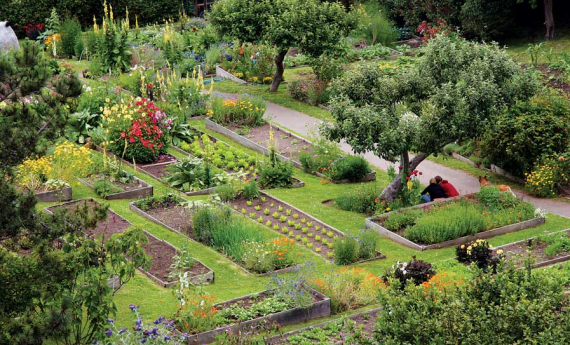
What is permaculture?
Translated from English, it means “permanent agriculture.” Permaculture combines and utilizes traditional farming methods and modern technologies, as well as non-disruptive intervention in natural processes, within a single integrated system.
The main principle of permaculture-based farming is to create a system of organic agriculture that integrates all types of farming activities into a single cycle. It is a form of agricultural production in which all elements surrounding a person (and their family)—such as the home, vegetable garden, orchard, fence, backyard farm, livestock, irrigation system, natural fertilizers, and so on—are integral parts of a single system.
The main goal of permaculture is the nonviolent return of all expended energy losses to the created system. Thus, according to the principles of permaculture, the application of mineral fertilizers and toxic chemicals constitutes an act of violence against the natural ecosystem. The use of waste from livestock, poultry, and humans (manure, chicken droppings, compost, and other household waste) represents the return to a unified cycle of substances that have left the farm system.
For example: kitchen waste is turned into compost, which is then added to the soil as fertilizer. As it decomposes through the action of microorganisms, it transforms into humus, providing readily available nutrients for vegetable gardens, orchards, and other crops, which will then be used to feed livestock and poultry, and these animals will in turn serve as food for humans, and so on. Waste from sanitary facilities, after being treated with effective microorganisms (EM cultures), will become suitable for irrigation and incorporation into the soil. After reclamation, natural marshes will be transformed into ponds with charming recreational areas and a source of water for irrigation.
Key Differences Between Permaculture and Other Farming Methods
1. The absence of a traditional crop rotation. Plants grow under natural conditions based on companion planting (potatoes with beans, strawberries with garlic, peppers and eggplants in the same field, etc.) alongside grasses, shrubs, and fruit trees.
2. A design plan for the entire plot that optimizes crop placement to minimize labor costs for planting, maintenance, harvesting, etc. For example: crops that require frequent watering are arranged in a star pattern radiating from the water source, like the petals of a daisy (cucumbers, tomatoes, strawberries, and other water-loving crops), which reduces the time and labor required to deliver water and irrigate.
3. Providing the plot with moisture without using artesian wells, boreholes, or dug wells. Moisture accumulates in water bodies created by altering the plot’s surface (a natural basin, a pond, or an elevated area from which water will flow by gravity onto the field). When constructing such water bodies, the use of heavy equipment is permitted, but concrete and plastics must not be used to line the banks (only natural barriers are allowed).
4. Construction of dwellings and other outbuildings using only natural materials.
5. Use of established plant and animal varieties, allowing for their symbiotic interaction.
6. The farm must have a diversity of plants and animals to produce a wide range of products and provide the necessary nutrients for the plants.
Practical Application of Permaculture Techniques
Permaculture involves the use of natural “fertilizers” to enhance the soil’s natural fertility and provide plants with nutrients. To achieve this, an eco-farm must include:
- A designated area for the decomposition of manure and compost, as well as the treatment of sanitary waste (from composting toilets, water from showers, baths, laundry, and dishwashing).
- Construction of a chicken coop (to obtain poultry manure for fertilizer and meat for the diet). On a large farm, this includes raising cattle and horses (manure, milk, meat, and draft animals).
- Producing organic fertilizer independently using manure or red California worms—vermicomposting.
Two types of worms are involved in the creation and distribution of biofertilizer: humus producers and humus consumers/distributors. Members of the first group live beneath the topsoil. They feed on all organic waste and a portion of the soil (in a 9:1 ratio, respectively). This process produces vermicompost, from which humus is formed with the help of beneficial fungal and bacterial microorganisms.
The second group of worms inhabits the lower layers of the soil. They are called humus-eaters. They create a large number of tunnels in the soil, thereby increasing its aeration. Using the processed organic matter, biohumus is mixed with the soil, deepening the layer of fertile soil. The finished biohumus is applied to vegetable and fruit crops as a top-dressing or as a base fertilizer.
- Protection against diseases and pests is achieved using infusions, decoctions, and extracts from plants with fungicidal and insecticidal properties. The developers of the permaculture system reject the use of synthetically produced chemicals. I believe, however, that the use of biological products can still be permitted, at least during the initial stages of establishing such an ecosystem.
Practical Application of Permaculture
Permaculture involves the use of natural “fertilizers” to enhance the soil’s natural fertility and provide plants with nutrients. To achieve this, an eco-farm must include:
- A designated area for composting manure, compost, and treating sanitary waste (from a composting toilet, as well as water from showers, baths, laundry, and dishwashing).
- Construction of a chicken coop (to obtain poultry manure for fertilizer and meat for the diet). On a large farm, this includes raising cattle and horses (manure, milk, meat, and draft animals).
- Producing organic fertilizer independently using manure or red California worms—vermicomposting.
Two types of worms are involved in the creation and distribution of biofertilizer: humus producers and humus consumers/distributors. Members of the first group live beneath the topsoil. They feed on all organic waste and a portion of the soil (in a 9:1 ratio, respectively). This process produces vermicompost, from which humus is formed with the help of beneficial fungal and bacterial microorganisms.
The second group of worms inhabits the lower layers of the soil. They are called humus-eaters. They create a large number of tunnels in the soil, thereby increasing its aeration. Using the processed organic matter, biohumus is mixed with the soil, deepening the layer of fertile soil. The finished biohumus is applied to vegetable and fruit crops as a top-dressing or as a base fertilizer.
- Protection against diseases and pests is achieved using infusions, decoctions, and extracts from plants with fungicidal and insecticidal properties. The developers of the permaculture system reject the use of synthetically produced chemicals. I believe, however, that the use of biological products can still be permitted, at least during the initial stages of establishing such an ecosystem.
Practical Application of Permaculture
Permaculture involves the use of natural “fertilizers” to enhance the soil’s natural fertility and provide plants with nutrients. To achieve this, an eco-farm must include:
- A designated area for composting manure, compost, and treating sanitary waste (from a composting toilet, as well as water from showers, baths, laundry, and dishwashing).
- Construction of a chicken coop (to obtain poultry manure for fertilizer and meat for the diet). On a large farm, this includes raising cattle and horses (manure, milk, meat, and draft power).
- Producing organic fertilizer independently using manure or red California worms—vermicomposting.
Two types of worms are involved in the creation and distribution of biofertilizer: humus producers and humus consumers/distributors. Members of the first group live beneath the topsoil. They feed on all organic waste and a portion of the soil (in a ratio of 9:1, respectively). This process produces vermicompost, from which humus is formed with the help of beneficial fungal and bacterial microorganisms.
The second group of worms inhabits the lower layers of the soil. They are called humus-eaters. They create a large number of tunnels in the soil, thereby increasing its aeration. Using the processed organic matter, biohumus is mixed with the soil, deepening the layer of fertile soil. The finished biohumus is applied to vegetable and garden crops as a top-dressing or as a base fertilizer.
- Protection against diseases and pests is achieved using infusions, decoctions, and extracts from plants with fungicidal and insecticidal properties. The developers of the permaculture system reject the use of synthetically produced chemicals. I believe, however, that the use of biological products can still be permitted, at least during the initial stages of establishing such an ecosystem.
It is more reliable and safer to protect plants from diseases and pests using biological products—biofungicides and bioinsecticides—made from beneficial microorganisms (fungi and bacteria). Biofungicides include Fitosporin, Barrier, Zaslon, Fitop, Integral, Bactofit, Agat, Planzir, Trichodermin, Gamair-P, Glyocladin, and others.
Among bioinsecticides, the most popular are Bitoxibacillin, Boverin, Aktophit (Akarin), Fitoverm, Lepidocide, Metarizin, Nematofaghin, Dachnik, and Verticillin.
They are safe for plants, family members, animals, birds, and fish. Some biological products can be used to treat plants right up until harvest.
Of course, using them would, to some extent, violate permaculture principles. However, since they are biological products, their use does not conflict with natural farming practices. The use of decoctions, infusions, and extracts from herbs, roots, and leaves of wild and cultivated plants—as recommended by permaculture—does not always produce the expected results. For example, orange peels, onion skins, garlic cloves, tobacco dust, calendula flowers, and others are ineffective when plants are severely infested during years of epiphytotic outbreaks.
Please note! Decoctions and infusions of certain herbs have strong toxic properties. Be careful and exercise caution when using hemlock, aconite, hogweed, or black henbane. Simply eating unwashed fruit or vegetables after spraying with such a natural decoction is enough to cause severe poisoning.
In conclusion, I want to warn the reader that managing a farm using a closed-loop permaculture system is not something every farmer can handle. This requires knowledge, skill, experience working in agriculture, and, of course, living year-round within the self-sustaining system you’re creating—one capable of meeting your own needs and processing your own waste. Visiting the cottage 1–2 times a week or only on Sundays will not yield the desired results.